
The Collective Intelligence Network Support Unit (CINSU) provides facilitation support for teams and groups working to address complex issues across a variety of organizational, societal, and research contexts. CINSU members use John Warfield’s methodology, Interactive Management (IM), combined with other collective intelligence methods (e.g., scenario-based design) to maximize team intelligence and collective action.
Central to Warfield’s methodology are a number of basic steps:
- First, a group of key stakeholders with an interest in addressing a complex issue, or resolving a problematic situation, come together in a specially configured room and are asked to generate a set of ‘raw’ ideas (commonly 50 – 200) about what might potentially have a bearing on the issue. Idea clarification, categorisation, and voting helps the group to generate a field representation of the complex landscape and identify the sub-set of ideas that are most central to the issue (see step 1 & 2 in Figure 1 below).
- Next, using collective intelligence (ISM) matrix-based structuring software, the relationship between ideas is deliberated upon by the group systematically (i.e., multiple, pairwise relational deliberation) using a session-specific relational question (e.g., “Does problem A significantly aggravate problem B?”). Unless there is majority consensus, the relation does not appear in the final analysis.
- After all pairwise decisions have been made by the group, the CI software generates a graphical structure (or problematique) showing how the ideas are interrelated. The problematique can be viewed and printed for discussion.
- The problematique becomes the launch pad for further deliberation and action planning. The logical structure of relations under consideration is visible in the problematique and when generating solutions or action plans.
- When the group is satisfied that they have modelled both the various components of the issue at hand, and devised the best possible set of solutions or actions, the CI session closes and each member leaves with a detailed action plan, a specific set of goals to work on, and the roadmap and logic describing how all the various plans and goals of each member will work together to address the complex issue.
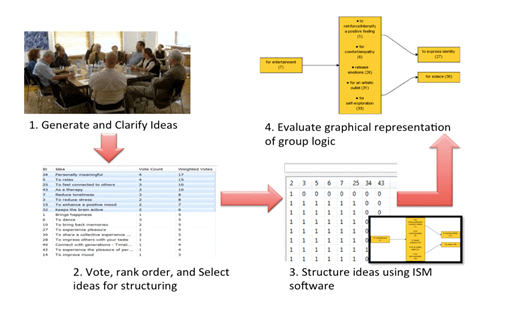
Figure 1: A simple visual description of some of the key steps in the CI methodology
The ISM software is available to download here. We have also authored an Interpretative Structural Modelling (ISM) Overview and User Guide for Collective Intelligence Facilitation.
CI has been applied in many different situations to accomplish many different goals, including mediating peacebuilding in protracted conflicts (Broome, 2006; 2017), improving Tribal governance process in Native American communities (Broome, 1995a, 1995b; Broome & Christakis, 1988; Broome & Cromer, 1991), developing a national well-being measurement framework (Hogan et al., 2015), mobilising communities across Europe in response to marine sustainability challenges (Domegan et al., 2016), understanding the nature and causes of sabotage in the University Sector (Wallace et al., 2018), understanding and overcoming barriers to the design of personalised nutrition products and services for older adults (Hogan, Harney, & Walsh, 2017), enhancing the implementation and sustainability of fundamental movement skills training (Ma et al., 2021), and training facilitators (Broome & Fulbright, 1995). ISM can also be very useful as a research tool (see Razzante et al., 2023), and IM is one amongst a set of methods that students can learn to apply in the broader context of Education for Collective Intelligence.
The IM method has also been combined with other methods, including argument mapping (e.g., in an educational training context; Hogan et al., 2014), scenario-based design (i.e., in a variety of EU projects focused on technology innovation; Long et al., 2017; Hogan et al., 2017), and psychometrics (i.e., in scale development projects that ground factor analysis work in CI model conceptualization; Groarke & Hogan, 2016).
Within the local University context where CINSU was established in 2018, project work has focused on:
– Supporting University Governors with Risk Management Project Work
– Supporting Project Work for the Office of the Vice President for Equality and Diversity
– Supporting Well-Being project work for NUI, Galway, Hardiman Library Staff
– Supporting Well-Being project Work for the NUI, Galway, LGBT+ Staff and Student Network
– Supporting Multiple Research Teams and Research Students
These and other local, national, and EU CINSU projects can be seen in figure 2 below. A categorised list of projects and reports across problem domains is presented further below.
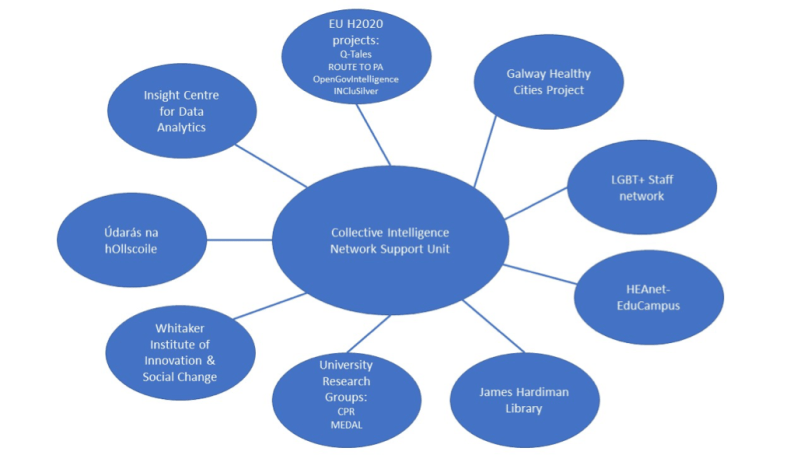
Figure 2: CINSU Projects
Project leaders can contact michael.hogan@universityofgalway.ie for more information on CINSU facilitation and workshop opportunities.
CINSU Members
Owen Harney, School of Psychology, University of Galway
Jenny Groarke, School of Psychology, University of Galway
Chris Noone, School of Psychology, University of Galway
Cormac Ryan, School of Psychology, University of Galway
Eric Van Lente, School of Psychology, University of Galway
Tony Hall, School of Education, University of Galway
Monika Pilch, School of Psychology, University College Dublin
Siobhan O’Higgins, School of Psychology, University of Galway
John O’Reilly, School of Education, University of Limerick
Mike Moroney, J.E. Cairnes School of Business & Economics, University of Galway
Jane Walsh, School of Psychology, University of Galway
Su-Ming Khoo, School of Sociology, University of Galway
Michelle Hanlon, School of Psychology, University of Galway
Hannah Durand,
Jiani Ma, Centre for Sports, Exercise and Life Sciences, Coventry University
Robert Razzante, Arizona State University
Bianca Pereira, Data Science Institute, University of Galway
Ann Colleran, School of Psychology, University of Galway
Michael Hogan, School of Psychology, University of Galway
Benjamin Broome, Arizona State University
Collective Intelligence Projects and Reports
Health and wellbeing
Malaria testing and treatment
Harney, O. M., Hogan, M.J., Walsh, J. C., Groarke, J. M., Mademtzoglou, D., Howes, R., Randrianarisoa, M., Harimanana, A., Emiru, T., & Tsega, T. (2023). PvSTATEM Collective Intelligence report (95 pp). European Commission Horizon Research and Innovation Actions Programme, Brussels.
Groarke, J. M., Walsh, J. C., Harney, O. M., Hogan, M. J., & Howes, R. (2023). PvSTATEM mHealth Strategy Report (69 pp). European Commission Horizon Research and Innovation Actions Programme, Brussels.
Medication adherence
Morrissey, E. C., Harney, O. M., Hogan, M. J., Murphy, P. J., O’Grady, L., Byrne, M., Casey, M., Duane, S., Durand, H., Hayes, P., McDevitt, C., Mockler, D., Murphy, M., Towers, P., Murphy, A. W., & Molloy, G. J. (2024). Supporting General Practitioners and people with hypertension to maximise medication use to control blood pressure: the contribution of Collective Intelligence to the development of the ‘Maximising Adherence, Minimising Inertia’ (MIAMI) intervention. Health Psychology and Behavioral Medicine, 12(1), 2404038. https://doi.org/10.1080/21642850.2024.2404038
Hanlon, M., Hogan, M., Durand, H., Pilch, M., Harney, O., Molloy, G., & Murphy, A. (2020). Designing an e-learning tool to support health practitioners caring for patients taking multiple medications. HRB Open Research, 3(59). doi:10.12688/hrbopenres.13110.1
Chronic Pain
O’Reilly, P. M., Harney, O. M., Hogan, M. J., Mitchell, C., McGuire, B. E., & Slattery, B. (2022). Chronic pain self-management in middle-aged and older adults: A collective intelligence approach to identifying barriers and user needs in eHealth interventions. Digital Health. https://doi.org/10.1177/20552076221105484
Hogan, M. J., Hanlon, M., O’ Higgins, S., O’ Grady, B., & Flynn, J. (2019). The Centre for Pain Research: Working with patients and the public to learn the best way to communicate our research findings. Collective Intelligence Network Support Unit (CINSU). NUI, Galway. (55pp.).
Fundamental Movement Skill
Ma, J., Hogan, M. J., Eyre, E. L. J., Lander, N., Barnett, L. M., & Duncan, M. J. (2021). Using Collective Intelligence to identify barriers to implementing and sustaining effective Fundamental Movement Skill interventions: A rationale and application example. Journal of Sports Sciences, 39 (6), 691-698.
Ma, J., Hogan, M. J., Eyre, E. L. J., Lander, N., Barnett, L. M., & Duncan, M. J. (2021). Enhancing the implementation and sustainability of fundamental movement skill interventions in the UK and Ireland: lessons from collective intelligence engagement with stakeholders. International Journal of Behavioral Nutrition and Physical Activity, 18(1), 144. doi:10.1186/s12966-021-01214-8
Adolescent mental health services
Colleran, A., O’Connor, A., Hogan, M., Harney, O., Durand, H., & Hanlon, M. (2021). Who asked you? Young People and practitioners identify ways to facilitate access to mental health supports. HRB Open Research, 4(74). doi:10.12688/hrbopenres.13328.1
Adaptive functions of music-listening
Groarke, J. M., & Hogan, M. J. (2015). Enhancing wellbeing: An emerging model of the adaptive functions of music listening. Psychology of Music, 44(4), 769–791. https://doi.org/10.1177/0305735615591844
Groarke, J. M., & Hogan, M. J. (2018). Development and Psychometric Evaluation of the Adaptive Functions of Music Listening Scale. Frontiers in Psychology, 9(516).
Oneness
Van Lente, E., & Hogan, M. J. (2020). Understanding the Nature of Oneness Experience in Meditators Using Collective Intelligence Methods. Frontiers in Psychology, 11(2092). doi:10.3389/fpsyg.2020.02092
Van Lente. E., Hogan. M. J. (In Preparation). Development and psychometric evaluation of the Oneness Experiences Scale. Frontiers in Psychology.
Community well-being
Hogan, M. J., Johnston, H., Broome, B., McMoreland, C., Walsh, J., Smale, B., Duggan, J., Andriessen, J., Leydon, K. M., Domegan, C., McHugh, P., Hogan, V., Harney, O., Groarke, J., Noone, C., & Groarke, A. (2015). Consulting with citizens in the design of wellbeing measures and policies: lessons from a systems science application. Social Indicators Research, 123, 857-87.
Hogan, M. J., Broome, B., Harney, O. M., Noone, Groarke, J. M., C. Ryan, C., Devaney, M., Murray, C., McTiernan, A., McKenna Plumley, P., Kavanagh, C., & Irwin, A. (2015). Galway City Community Network PPN Collective Intelligence Report (40 pp). Galway Community Network.
Hogan, M. J. & Broome, B., Harney, O.M. & Noone, C. (2014). Wellbeing in Galway City – Overcoming Barriers to Well-Being in Galway: Collective Intelligence Report. (38 pp.) Whitaker Institute, NUI Galway, Galway, Ireland.
Hogan, M. J. & Broome, B., Harney, O.M. & Noone, C. (2013). Wellbeing in Ireland – Designing Measures and Implementing Policies: Collective Intelligence Conference Report. Whitaker Institute, NUI Galway, Galway, Ireland.
Hogan, M. J., Broome, B., Harney, O.M. & Noone, C. (2012). Overcoming Barriers to Well-Being in Ireland: Collective Intelligence Conference Report. Whitaker Institute, NUI Galway, Galway.
Relationships and well-being
Burke, K., & Hogan, M.J. (2015). Factors Associated with Romantic Relationship Satisfaction in Younger and Older Adulthood: An Exploratory Study. The Irish Psychologist, 41(4), 77-81.
Advance care planning
Pilch, M., Hayes, C.B., Harney, O., Doyle, F., Thomas, S., Cooper Lunt, V. and Hogan, M. (2025), Using Collective Intelligence to Develop Design Requirements for a Complex Intervention for Advance Care Planning in the Community. J Clin Nurs, 34: 230-246. https://doi.org/10.1111/jocn.17549
Education
Khoo, S.-m., Harney, O., Hogan, M., Prinsloo, P., Algers, A., Belluigi, D., Brink, C., Buckley, L.-A., Carolissen, R., Cheng, M., Cronin, C., Czerniewicz, L., & Stein, S. Connecting the challenges of quality and equality in higher education using the collective intelligence approach: findings from an international expert panel. Quality in Higher Education, 1-25. https://doi.org/10.1080/13538322.2024.2357866
Khoo, S., Harney, O. M., Prinsloo, P., & Hogan, M. J. (2021). Building Collaborative Approaches to University Strategies against Exclusion in Ireland and Africa. Higher Education Futures Taskforce Call for Input on Research and Innovation. Royal Irish Academy.
Harney, O. M., Hogan, M. J., Khoo, S., & Prinsloo, P. (2021). B-CAUSE: Building Collaborative Approaches to University Strategies against Exclusion in Ireland and Africa: pedagogies for quality Higher Education and inclusive global citizenship – Report on NUI Galway Collective Intelligence Session. Collective Intelligence Network Support Unit (CINSU). NUI, Galway (62 pp.)
Harney, O. M., Hogan, M. J., Khoo, S., & Prinsloo, P. (2020). B-CAUSE: Building Collaborative Approaches to University Strategies against Exclusion in Ireland and Africa: pedagogies for quality Higher Education and inclusive global citizenship – Report on Panel of Experts Collective Intelligence Session. Collective Intelligence Network Support Unit (CINSU). NUI, Galway (59 pp.)
Harney, O. M., Khoo, S.M., Prinsloo, P. & Hogan, M. J. (2020, September). B-CAUSE project: Learnings to date. Oral presentation at ‘A Better World’ Learning Event: Irish Research Council COALESCE programme and Department of Foreign Affairs. Dublin, Ireland (online).Thompson Long, B., Hall, T., Hogan, M., Harney, O., Doukoulos, T., & Murray, C. (2017). Using a Collective Intelligence Scenario-Based Design approach to develop a collaboration ecosystem supporting the authorship of pedagogically valuable e-books for children. The Journal of Literacy and Technology, 18(2).
Dwyer, C. P., Hogan, M. J., Harney, O. M., & Kavanagh, C. (2017). Facilitating a student-educator conceptual model of dispositions towards critical thinking through interactive management. Educational Technology Research and Development, 65(1), 47-73.
Dwyer, C. P., Hogan, M. J., Harney, O. M., & O’Reilly, J. (2014). Using interactive management to facilitate a student-centred conceptualisation of critical thinking: a case study. Educational Technology Research and Development, 62(6), 687-709.
Hogan, M. J., Long, B., Hall, T., Harney, O. M., Petacchi, D., & Pestula, M. (2015). A Collaboration Ecosystem enabling EU Creative SMEs to exchange multi-media content and create multi-plot, interactive Apps for Children, curated according to Reader ability and educational value. Q-Tales: Stakeholder Requests Document (92 pp). European Commission for Horizon ICT Research and Innovation Programme, Brussels.
Equality, Diversity, and Inclusion
Hogan, M. J., Hanlon, M., & Harney, O. M. (2018). Advancing the collaborative work of the Equality, Diversity and Inclusion Committee (EDIC), and the Equality, Diversity, and Inclusion Campus Committee (EDICC). Collective Intelligence Network Support Unit (CINSU). NUI, Galway. (42pp.).
Hogan, M. J., Harney, O. M., & Ryan, C. (2019). Developing SMART actions for Equality, Diversity, and Inclusion. Collective Intelligence Network Support Unit (CINSU). NUI, Galway. (72pp.).
Noone, C., & Hogan, M. J. (2017). LGBT Staff Network Strategy Meeting. Collective Intelligence Network Support Unit (CINSU). NUI, Galway. (12pp.).
Organisational / Workplace
Wallace, E., Hogan, M., Noone, C., & Groarke, J. (2019). Investigating components and causes of sabotage by academics using collective intelligence analysis. Studies in Higher Education, 44(12), 2113-2131.
Hogan, M. J., & Harney, O. M. (2017). Challenges facing incoming Governors of Údarás na hOllscoile (2016-2021), individually and as a collective, to ensure best practice in governance of the University during a period of major transition. Collective Intelligence Network Support Unit (CINSU). NUI, Galway. (27pp.).
Hogan, M. J., Harney, O. M., Ryan, C., & Noone, C. (2018). Well-being at work in the library. Collective Intelligence Network Support Unit (CINSU). NUI, Galway. (76pp.).
Hogan, M. J., & Harney, O. M. (2017). Risk management. Collective Intelligence Network Support Unit (CINSU). NUI, Galway. (32pp.).
Governance, open data, and technology
Danaher, J., Hogan, M. J., Noone, C., Kennedy, R., Behan, A., De Paor, A., Felzmann, H., Haklay, M., Khoo, S.-M., Morison, J., Murphy, M. H., O’Brolchain, N., Schafer, B., & Shankar, K. (2017). Algorithmic governance: Developing a research agenda through the power of collective intelligence. Big Data & Society, 4(2). https://doi.org/10.1177/2053951717726554
Hogan, M., Ojo, A., Harney, O., Ruijer, E., Meijer, A., Andriessen, J., Pardijs, M., Boscolo, P., Palmisano, E., Satta, M., Groff, J., Baker, M., Détienne, F., Porwol, L., Scarano, V., & Malandrino, D. (2017). Governance, Transparency and the Collaborative Design of Open Data Collaboration Platforms: understanding barriers, options, and needs. In A. K. Ojo, & J. Millard (Eds.), Government 3.0: Next Generation Government Technology Infrastructure and Services (pp. 299 – 332). Springer.
Scarano V, Malandrino D, Baker M, Détienne, F., Andriessen, A., Pardijs, M., Ojo, A., Hogan, M.J., Meijer, A., Ruijer, E. (2017). Fostering Citizens’ Participation and Transparency with Social Tools and Personalization. In A. K. Ojo, & J. Millard (Eds.), Government 3.0 – Next Generation Government Technology Infrastructure and Services (pp. 197-218). Springer.
Lowry, E., Hogan, M.J., Moriarty, J., Harney, O., Ruijer, E., Pilch, M., Groarke, J.M., Hanlon, M., Shuttleworth, I. (2023). Using collective intelligence methods to improve government data infrastructures and promote the use of complex data: The example of the Northern Ireland Longitudinal Study. Health Research Policy and Systems 21, 134. https://doi.org/10.1186/s12961-023-01070-x
Hogan, M. J., Hanlon, M., & Harney, O. M. (2019). Advancing the collaborative work of HEAnet and EduCampus. Collective Intelligence Network Support Unit (CINSU). NUI, Galway. (63pp.).
Hogan, M. J., Harney, O. M., Boscolo, P., Palmisano, E., Andriessen, J., Ruijer, E., Groff, J., & Ojo, A. (2016). Route to PA: User stories on Open Data and Transparency (380 pp). European Commission for Horizon ICT Research and Innovation Programme, Brussels.
Soch, N., Hogan, M.J., Harney, O., Hanlon, M., Brady, C., McGrattan, L. (2022). Developing a Utopian Model of Human-Technology Interaction: Collective Intelligence Applications in Support of Future Well-Being. Utopian Studies, 33 (1): 54–75. doi: https://doi.org/10.5325/utopianstudies.33.1.0054
Hogan, M. J., Harney, O. M., Groarke, J. M., & Pilch (2019). Northern Ireland Longitudinal Study (NILS) Infrastructure Design: Accessing, understanding, and using the NILS data for research purposes and to guide policy, practice and action. Collective Intelligence Network Support Unit (CINSU). NUI, Galway. (72 pp.).
Environment
McHugh, P., Domegan, C., Duane, S., Joyce, J., Devaney, M., Hogan, M.J., Broome, B.J., Mazzonetto, M., and Piwowarczyk, J. (2017). Seas of energy: Using a Systems Research Approach for a Wicked Problem. In Social Marketing: Rebels with a Cause. UK: Routhledge.
Domegan, C., Devaney, M., McHugh, P., Hogan, M. J., & Broome, B. (2014) Waves of Change: Collective Design for a Sustainable Marine Ecosystem – EU Report D2.4 Global Analysis of the SFS Consultation Process from a Social Sciences Perspective, Brussels. (134 pp).
Business and innovation
Rezaei-Zadeh, M., Hogan, M. J., O’Reilly, J., Cleary, B., & Murphy, B. (2014). Using Interactive Management to Identify, Rank, and Model Entrepreneurial Competencies. Journal of Entrepreneurship, 23(1), 57-94.
Hogan, M. J, Harney, O. M., & Walsh, J. C. (2017). INCluSilver: Report on Collective Intelligence Design Sessions (56 pp). European Commission for Horizon 2020 Industrial Leadership Programme, Brussels.
Hogan, M. J., Harney, O. M., Hanlon, M., Pilch, M., & Walsh, J. C. (2021). Personalised nutrition for older adults: design challenges, SME barriers, and options and competencies for innovation. International Journal of Food Sciences and Nutrition, 1-15. doi:10.1080/09637486.2020.1869922
References
Broome, B. J. (2006). Applications of Interactive Design Methodologies in Protracted Conflict Situations, in Lawrence Frey (Ed.), Facilitating group communication in context: Innovations and applications with natural groups, pp. 125-154, Hampton Press.
Broome, B.J. (2017). Mediating Peacebuilding in Protracted Conflicts: An Interactive Design Framework, in A. Georgakopoulos (Ed), The Mediation Handbook: Research, Theory, and Practice (pp. 379-387), Routledge.
Broome, B. J. (1995a). Collective design of the future: Structural analysis of tribal vision statements. American Indian Quarterly, 19, 205-228.
Broome, B. (1995b). The role of facilitated group process in community-based planning and design: Promoting greater participation in Comanche tribal governance. In L. R. Frey (Ed.), Innovations in group facilitation: Applications in natural settings (pp. 27-52). Cresskill, NJ: Hampton Press.
Broome, B. J., & Christakis, A. N. (1988). A culturally-sensitive approach to tribal governance issue management. International Journal of Intercultural Relations, 12, 107-123.
Broome, B. J., & Cromer, I. L. (1991). Strategic planning for tribal economic development: A culturally appropriate model for consensus building. International Journal of Conflict Management, 2, 217-234.
Broome, B. J., & Fulbright, L. (1995). A multi-stage influence model of barriers to group problem solving. Small Group Research, 26, 25-55.
Domegan, C., McHugh, P., Devaney, M., Duane, S., Hogan, M., Broome, B. J., et al. (2016). Systems-thinking social marketing: conceptual extensions and empirical investigations. Journal of Marketing Management, 1-22.
Groarke, J. M., & Hogan, M. J. (2016). Enhancing wellbeing: An emerging model of the adaptive functions of music listening. Psychology of Music, 44(4), 769-791.
Hogan, M., Harney, O., & Broome, B. (2014). Integrating Argument Mapping with Systems Thinking Tools: Advancing Applied Systems Science. In A. Okada, S.J. Buckingham Shum, & T. Sherborne (Eds.), Knowledge Cartography (pp. 401-421). London: Springer.
Hogan, M. J, Harney, O. M., & Walsh, J. C. (2017). INCluSilver: Report on Collective Intelligence Design Sessions (56 pp). European Commission for Horizon 2020 Industrial Leadership Programme, Brussels. Retrieved from https://www.inclusilver.eu/wp-content/uploads/2017/09/INCluSilver_D1.5_ReportonCollectiveIntelligenceSession.pdf
Hogan, M., Ojo, A., Harney, O. M., Ruijer, E., Meijer, A., Andriessen, J., … & Groff, J. (2017). Governance, transparency and the collaborative design of open data collaboration platforms: understanding barriers, options, and needs. In Government 3.0–Next Generation Government Technology Infrastructure and Services (pp. 299-332). Cham: Springer.
Hogan, M. J., Johnston, H., Broome, B., McMoreland, C., Walsh, J., Smale, B., Duggan, J., Andriessen, J., Leyden, K. M., Domegan, C., McHugh, P., Hogan, V., Harney, O.M. , Groarke, J., Noone, C. & Groarke, A. M. (2015). Consulting with Citizens in the Design of Wellbeing Measures and Policies: Lessons from a Systems Science Application. Social Indicators Research, 1-21.
Ma, J., Hogan, M.J., Eyre, E.L.J. et al. (2021). Enhancing the implementation and sustainability of fundamental movement skill interventions in the UK and Ireland: lessons from collective intelligence engagement with stakeholders. Int J Behav Nutr Phys Act 18, 144.
Razzante, R. J., Hogan, M., Broome, B., Tracy, S. J., Chawla, D., & Skurzak, D. M. (2023). Interactive Management Research in Organizational Communication. Management Communication Quarterly, 37(4), 971-989.
Thompson Long, B., Hall, T., Hogan, M., Harney, O., Doukoulos, T., & Murray, C. (2017). Using a Collective Intelligence Scenario-Based Design approach to develop a collaboration ecosystem supporting the authorship of pedagogically valuable e-books for children. The Journal of Literacy and Technology, 18(2).
Wallace, E., Hogan, M., Noone, C., & Groarke, J. (2018). Investigating components and causes of sabotage by academics using collective intelligence analysis. Studies in Higher Education, 1-19.
 Michael Hogan